

In the province of Ontario, you can see many different bodies of water that are striking in their beauty, writes toronto-name. They can really fascinate and attract attention for a long time. However, it is important to note that these objects are not only valuable from an aesthetic point of view, but their historical role is no less important. After all, many of them were once the sites of settlements of early peoples who lived a full lifestyle in a particular area. With the passing of time, the results of their life became evident in the numerous artifacts found by experts in these places. Therefore, such areas are extremely interesting to visit.
Lake Huron is one of the most valuable and popular. It is a part of the world-famous Great Lakes. This reservoir is conditionally divided into several parts. In particular, the northern and eastern parts of the lake are shared by the Canadian province of Ontario. Therefore, the reservoir is quite important for this area, and it’s hard to argue with that.
As for the name of the lake, it is associated with the first French explorers who decided to call the reservoir by that name. This name is dedicated to the Huron people who once lived in this region. But, as the practice shows, or rather the numerous testimonies from the past, some European nations have adopted their own names for the famous Canadian reservoir.
The beginning of the story
More than nine thousand years ago, when the water level of Lake Huron was about one hundred meters lower than it is today, a ridge called the Alpena-Amberley appeared. It was a land bridge that served as a migration route for large herds of caribou.
Unique structures
In 2008, archaeologists discovered stone structures near the flooded ridge. There were sixty of them!
Experts concluded that the Paleo-Indians used these structures as hunting shelters.
In addition, local traders organized obsidian mining in these places. This material was used to make various tools. This fact was confirmed once again in 2013, when regular research was conducted there.
Housing of the population at that time
Before the Europeans began to actively come to this area, the Indian community that lived there reached a level of rapid development. The proof of this is the archaeological evidence discovered near Lake Huron.
In addition, there were huge buildings in this area that housed six thousand people.
The question of maps
Interestingly, the French were the first Europeans to visit this region. They often named the lake in their own way.
For example, the French came up with their own name for the reservoir – “freshwater sea”.
Well, the following fact is an indisputable proof of it. In 1656, the French cartographer Nicolas Sanson marked the lake on his map in this way.
However, many early European maps referred to the lake as Lake Huron.
Rapid development
In the 1860s, the lake’s shoreline began to expand significantly, and more and more European settlements began to appear. In particular, Sarnia, the largest city on the lake.
The improvement and development of the area around the reservoir was quite rapid. From the 1900s, this process slowly moved into the 2000s.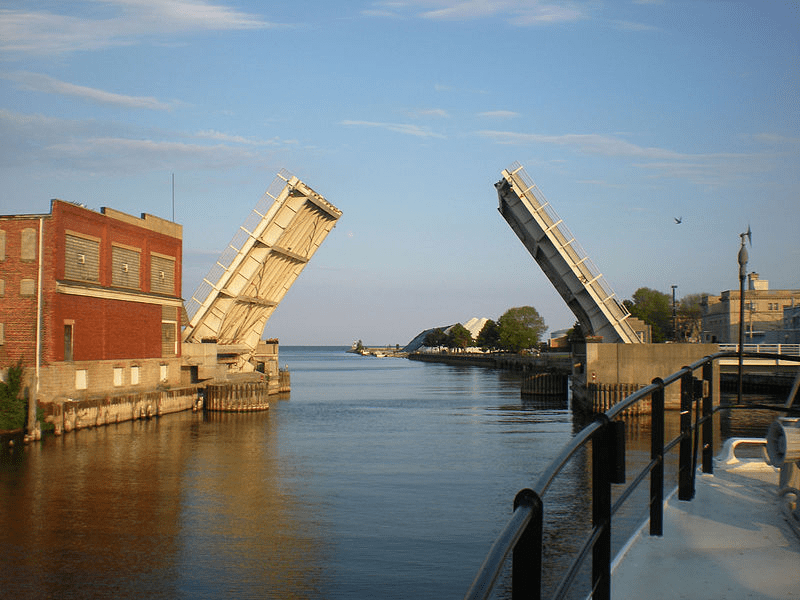
Thus, one of the most significant events in the modern history of the lake is the creation of the Water Management Department. It took place on October 26, 2010. Such measures were necessary to build a pipeline that started in the lake area and ended in Michigan, USA.
Photo: wikipedia