

Park · Toronto · ⭐ 9.3/10 · 4081 reviews · updated: 2026-08-03 23:54:25
Address: 339 Queens Quay W, Toronto, ON M5V 1A2, Canada
HTO Park — the urban beach that convinced Toronto its waterfront could be beautiful
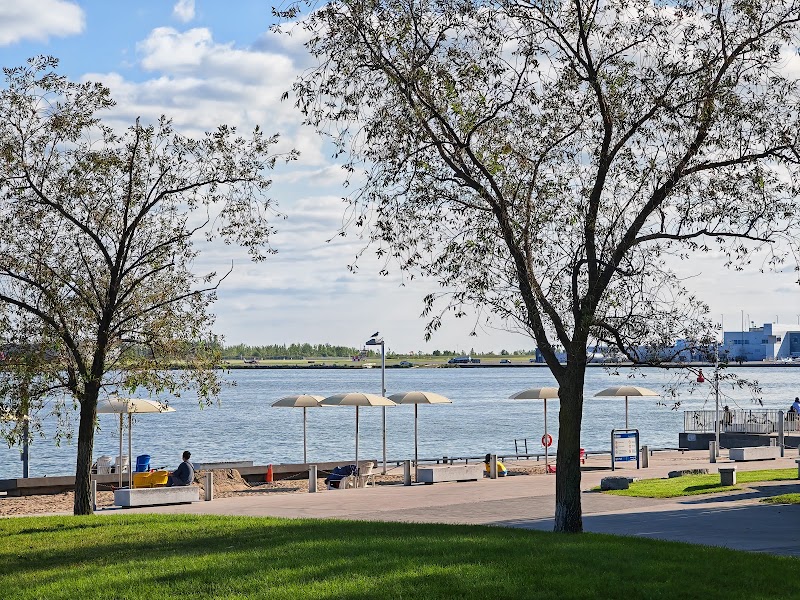
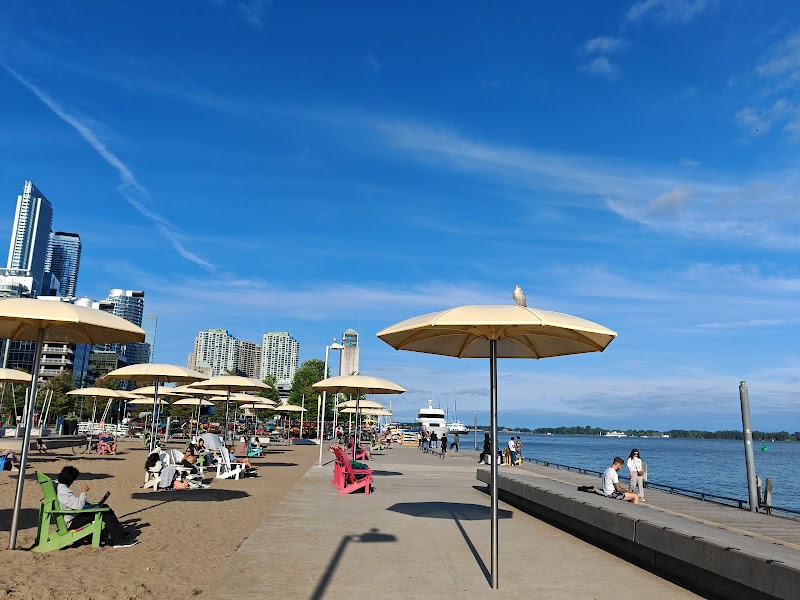
Sand, yellow steel umbrellas the size of small pavilions, Muskoka chairs facing open water, and behind them a run of green mounds rolling toward the city — HTO Park is barely more than two hectares, and it changed how an entire city thought about its shoreline. When it opened in 2007 it was the first significant new public space built on Toronto’s downtown central waterfront in decades, on ground that had been concrete quay and parking for most of a century. The name is a joke that stuck: H₂O with the chemical formula bent around TO, the local shorthand for Toronto. What makes it work is the refusal to pretend. This is not a resort beach and never claims to be — nobody swims here — but it is unmistakably a beach, in the middle of a downtown, with the Toronto Islands on the horizon and container-era infrastructure still visible on both sides.
Highlights
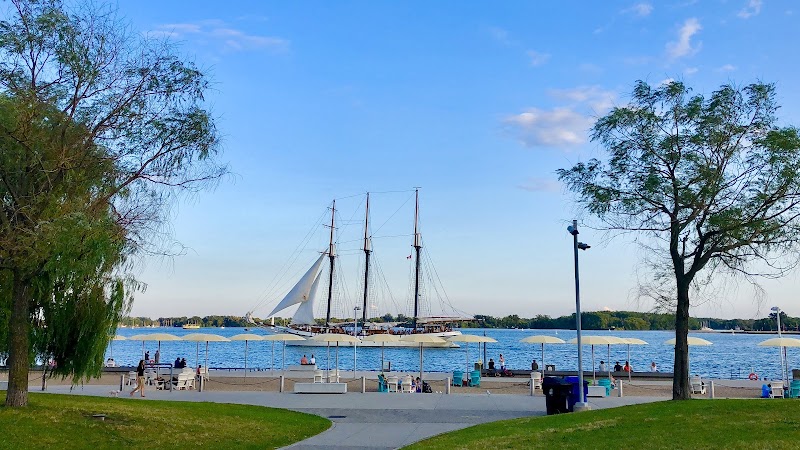
- The yellow umbrellas — enormous fixed steel parasols, the park’s signature and Toronto’s most photographed piece of street furniture. They are a direct quotation of Georges Seurat’s A Sunday Afternoon on the Island of La Grande Jatte, transplanting a nineteenth-century Parisian riverbank leisure scene onto a Canadian working harbour.
- The sand and the Muskoka chairs — a genuine sandpit at the water’s edge, furnished with the wide-armed wooden chairs Canadians call Muskoka chairs, all angled south toward the Islands. It is deliberately a place to sit rather than a place to swim.
- The grass mounds — a series of rolling green berms that lift the lawn above the flat quay, giving the park topography where there was none, sheltering the sand from traffic noise and doubling as sledding hills the moment there is snow.
- The Spadina WaveDeck — an undulating timber boardwalk at the park’s western edge, completed in 2009 as part of Waterfront Toronto’s wavedeck series. It hoops up and dips down over the water, and children treat it as playground equipment.
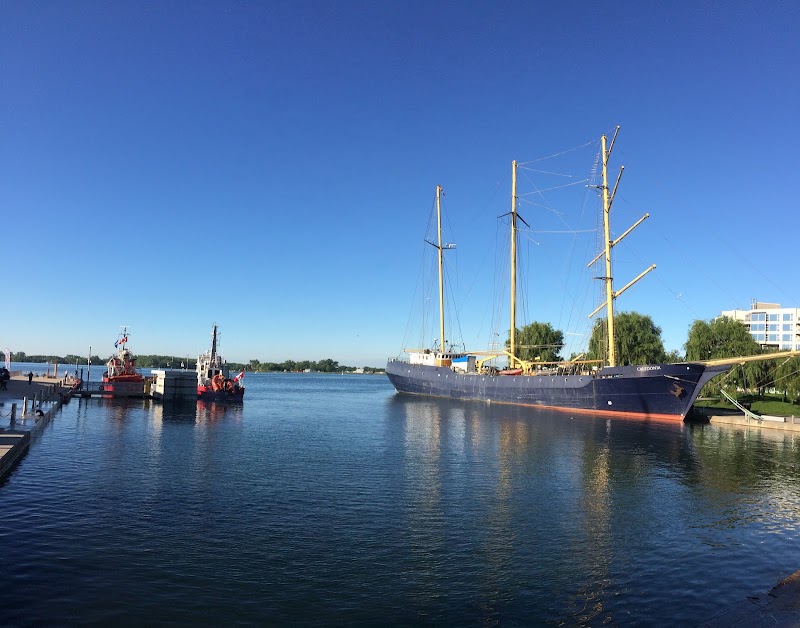
- The harbour outlook — an unobstructed south-facing view over the Inner Harbour: ferries crossing, sailing school dinghies swarming in summer, floatplanes and turboprops lifting off the island airport runway, and the low green line of the Islands behind it all.
- Two quays in one park — the western section sits on the eastern end of Maple Leaf Quay, the eastern section on the filled Peter Street Slip; both are concrete infill created during the 1920s port expansion, which is why the park’s edges are so sharply geometric.
What you’ll find
At 22,993 square metres the park is compact, and it is organized as a sequence of distinct ground surfaces rather than one open field — sand, lawn, mounds, boardwalk and hard plaza, each with a different use.
- An open sand beach area with fixed umbrellas and loose seating, free to use and open to everyone.
- Sloping lawn and berms for picnics, reading and lying in the sun, with the mounds offering some shelter from the wind.
- A continuous waterfront promenade linking into the Martin Goodman Trail and the Waterfront Trail, with cycling separated from pedestrians.
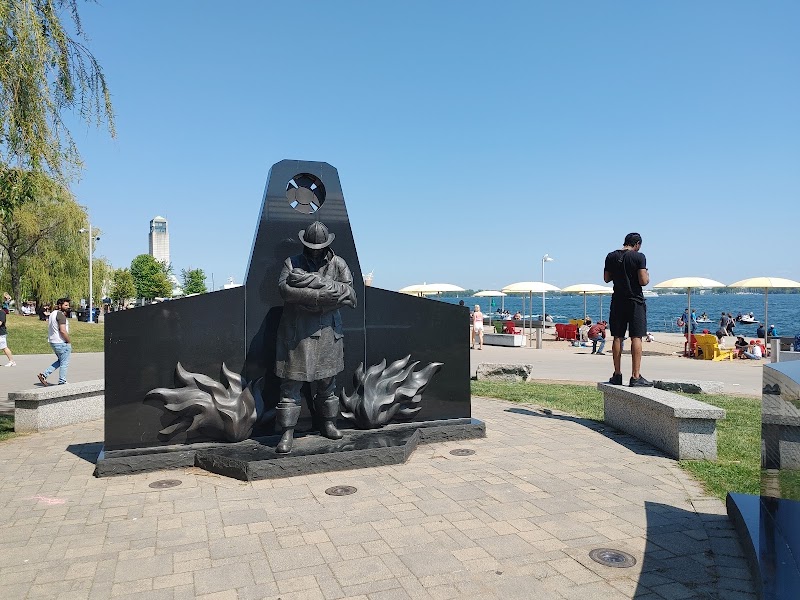
- Emergency services embedded in the park’s eastern section — Toronto Fire Services Station 334 and Toronto Paramedic Services Station 36 both operate from here.
- Seasonal food and drink from Harbourfront Centre and the Queens Quay strip a minute away, since the park itself carries no permanent concession.
- Neighbouring destinations within a short walk: Harbourfront Centre to the east, the Toronto Music Garden to the west, and Harbour Square Park and the Island ferry docks further east along the promenade.
Things to do — and who it’s for
- Downtown workers on a lunch break — the fastest available escape from the office towers, with real sand under your shoes fifteen minutes from the financial district.
- Photographers and designers — the umbrellas against the lake are a set piece, and the park is studied internationally as a case study in landscape architecture rather than just admired locally.
- Families with young children — sand to dig in, mounds to roll down, the wavedeck to run over and boats to point at, with no entry fee and no equipment needed.
- Cyclists and runners — the park sits directly on the city’s main waterfront route, so it functions as a natural rest stop rather than a detour.
- Visitors with an afternoon — chain it with Harbourfront Centre, the Music Garden and the ferry docks for a complete central waterfront walk without repeating a step.
- Anyone who wants the lake without leaving downtown — the water is right there, the breeze knocks several degrees off a July afternoon, and it costs nothing.
Getting there & practical
The park is on Toronto’s central waterfront, in the Harbourfront district immediately south of the entertainment and financial cores. From Union Station on Line 1 Yonge–University, take the 510 Spadina or 509 Harbourfront streetcar — both run in a tunnel from Union and surface at Queens Quay station, leaving a two-minute walk. The 510 Spadina route also connects north to Spadina station on Line 2 Bloor–Danforth and to Line 1 at Spadina, so the park is reachable from either subway line with one transfer. On foot it is roughly fifteen minutes south from Union Station. Entry is free with no gates or tickets; City of Toronto park hours apply, with public parks closed overnight. Half an hour is enough for a walk-through and a sit in the sand; an hour or two is more realistic on a warm day, and a full afternoon if you extend the walk along the promenade. There is no swimming here — the sand is for sitting, not for entering the water.
When to visit
Summer is what the park was built for: sand fully occupied by early afternoon, every umbrella claimed, sailing dinghies swarming the harbour, and the lake breeze making the waterfront several degrees more tolerable than the streets behind it. Late spring is arguably the sweet spot — the furniture is out, the lawn has recovered, and the crowds have not yet arrived. Autumn turns the park sharp and clear: fewer people, harder light on the yellow steel, migrating birds gathering in the harbour, and enough warmth in September to keep the chairs in use. Winter transforms it completely and is worth seeing precisely because so few people bother: the umbrellas stand over bare snow-covered sand like abandoned stage sets, the grass mounds become the neighbourhood’s sledding hills, and the Inner Harbour ices up in sheets with steam lifting off the open channels. Wind off the lake in January is severe and there is no shelter, so treat it as a short, bracing, extremely photogenic visit.
Good to know
None of this is natural shoreline. Both halves of the park stand on concrete infill created during the 1920s expansion of Toronto’s port: the western section occupies the eastern end of what was Maple Leaf Quay, and the eastern section covers the filled-in Peter Street Slip, a berth that once took working ships. For most of the twentieth century the central waterfront was rail, warehousing and parking, cut off from the city by an elevated expressway and a wall of tracks, and public access to the lake in the core was effectively nil. HTO Park was the first serious attempt to reverse that. Designed by a joint team of Janet Rosenberg & Studio, Claude Cormier Architectes Paysagistes and Hariri Pontarini Architects, it opened in 2007 as the first major public space delivered on the downtown waterfront in decades, and it functioned as a proof of concept for everything Waterfront Toronto has built since. The yellow umbrellas were the risk that paid off — a piece of unapologetic whimsy, referencing Seurat’s painting of Parisians at leisure on an island in the Seine, dropped into a post-industrial harbour. Claude Cormier went on to apply the same instinct at Canada’s Sugar Beach, which opened in 2010 further east with pink umbrellas and candy-striped rock, and at Berczy Park’s dog fountain in 2017; the umbrellas at HTO are where that language began in Toronto. The Spadina WaveDeck followed in 2009 at the park’s western edge, part of a set of curving timber decks that gave the harbour’s hard concrete edge a playful profile. In 2016 the park was added to the Landscape Performance Series case study briefs, a database of a few hundred built projects worldwide with measured environmental, economic and social benefits — a rare distinction for a park of this size, and a sign that its influence outran its footprint.
Visitor tips
- Do not plan on swimming — the beach is a sitting beach, not a bathing one, and the sand is there for chairs and sunlight rather than access to the water.
- On a hot summer weekend the umbrellas and chairs are gone by early afternoon; come before noon, or come at sunset when the west-facing water edge is at its best and the crowd has thinned.
- Treat the park as one stop on a promenade walk rather than a destination on its own — the Music Garden, Harbourfront Centre and the Island ferry docks are each a few minutes away along the same waterfront path.
Questions & answers
Can you swim at HTO Park? No. It is an urban beach designed for sitting, sunbathing and views, not for bathing. The sand, umbrellas and Muskoka chairs are the point; the water itself is a working harbour with ferry and floatplane traffic.
Is HTO Park free? Yes. It is public City of Toronto waterfront parkland with no admission charge, no gates and no reservations, open daily under standard city park hours.
What does the name mean? It is a play on H₂O, the chemical formula for water, with “TO” — the standard local abbreviation for Toronto — folded into it. The park is often styled HtO for that reason.
Why are the umbrellas yellow? They quote Georges Seurat’s painting A Sunday Afternoon on the Island of La Grande Jatte, transplanting a nineteenth-century scene of riverside leisure into a former industrial harbour. They have become the park’s identity and one of the most photographed objects on the waterfront.
Who designed it and when did it open? It opened in 2007, designed by a combined team of Janet Rosenberg & Studio, Claude Cormier Architectes Paysagistes and Hariri Pontarini Architects. It was the first significant new public space built on the downtown central waterfront in decades.
How big is the park? About 22,993 square metres, or roughly 247,500 square feet, split into a western section on the old Maple Leaf Quay and an eastern section on the filled Peter Street Slip.
How long should I spend there? Half an hour covers the sand, the mounds and the wavedeck. An hour or two is normal on a warm day, and a whole afternoon if you walk the promenade east to the ferry docks and west to the Music Garden.
Is it worth visiting in winter? Yes, for the strangeness of it. The umbrellas over snow-covered sand, the frozen harbour and the grass mounds serving as sledding hills make it one of the more memorable winter sights downtown — just come prepared, because there is no shelter from the lake wind.
Photos
Show 1 more photos
Visitor reviews
Reviews last updated: 2026-08-03 23:54:25
Data is refreshed monthly. Sources: toronto.name and editorial picks based on reviews.
The park offers a beautiful view of the cityscape and the waterfront, which adds to the peaceful atmosphere. It's a wonderful place to relax, unwind, and enjoy some time off. If you love nature and tranquility, HTO Park…
A great place for a pleasant walk or a run. I really enjoy strolling through this park. Wonderful views of the lake. A great spot for a picnic with family or just for some time alone. Recent additions to the park, with s…
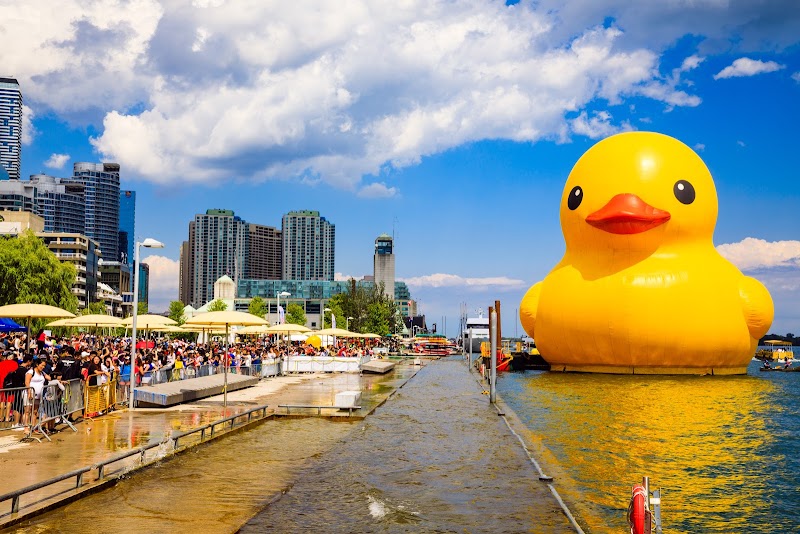
A perfect place for a quiet evening. This is my favorite spot to spend time alone with myself by the water, watching planes take off and land. Sometimes they also have some kind of prop in the water with a nice message.…
A wonderful place to relax right on the lakeshore. The grassy areas have trees for shade, and HTO Beach is a great big sandbox with umbrellas to soak up the summer atmosphere. Also visit Sugar Beach and park a little fur…