

Park · Toronto · ⭐ 9.5/10 · 3928 reviews · updated: 2026-08-03 23:54:26
Address: 35 Wellington St E, Toronto, ON M5E 1C9, Canada
Berczy Park — twenty-seven cast-iron dogs, one anxious cat, and the best small park in Toronto
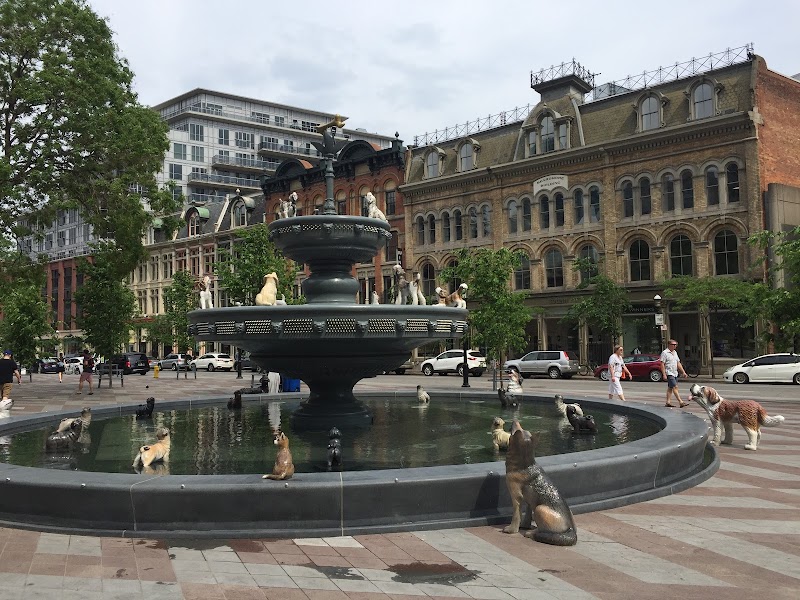
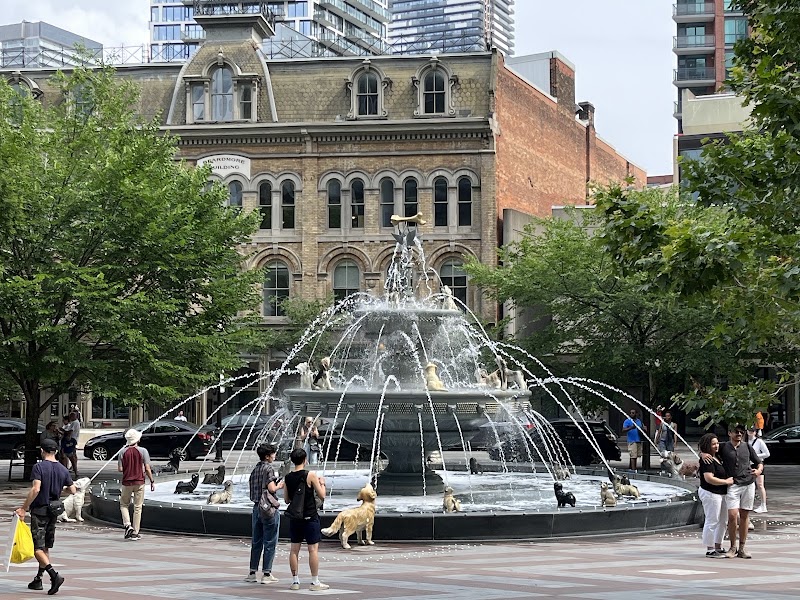
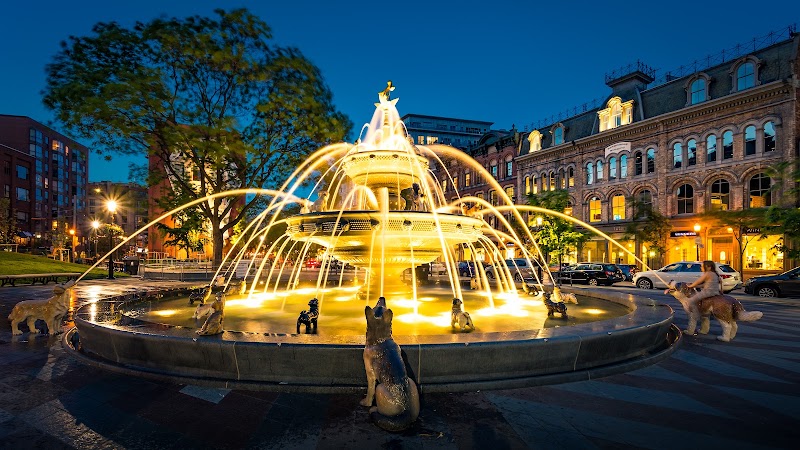
It is four-tenths of a hectare, a triangle of ground wedged between three converging streets in Old Town, and it is almost certainly the most photographed park of its size in Canada. The reason sits in the middle: a two-tier fountain ringed by twenty-seven life-size cast-iron dogs, every one of them a different breed, every one of them spouting water and staring upward at a golden bone balanced on the top. One cat refuses to play along. Behind the whole scene rises the Gooderham Building, Toronto’s flatiron, its rear wall covered by a painted illusion of windows that are not there. Berczy Park is a piece of deliberate, generous silliness executed at a very high level of craft, and the result is a downtown square where strangers actually talk to each other — usually about somebody’s dog.
Highlights
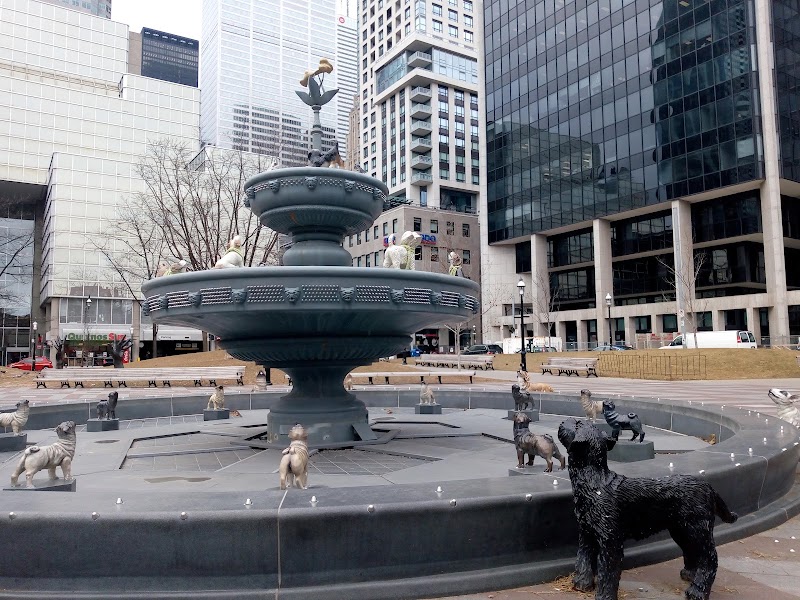
- The dog fountain — roughly five metres across and built in two tiers, with twenty-seven cast-iron dogs arranged around it, each sculpted as a distinct breed and each sending a jet of water toward the centre. A gilded bone crowns the whole assembly. It reopened with the park in June 2017 and became an instant civic landmark.
- Pam McCat — the single cat among the dogs, named for Councillor Pam McConnell, who drove the park’s rebuilding through. She is not looking at the bone like everyone else: she has spotted two birds perched nearby and is watching them instead. A second cat sits on an electrical box at the park’s southwest corner, entirely off the fountain.
- The drinking trough for real dogs — a shallow basin at ground level around the fountain’s base, put there so that actual dogs can drink while the iron ones spray. The park was designed for a neighbourhood that owns a very large number of dogs, and it shows.
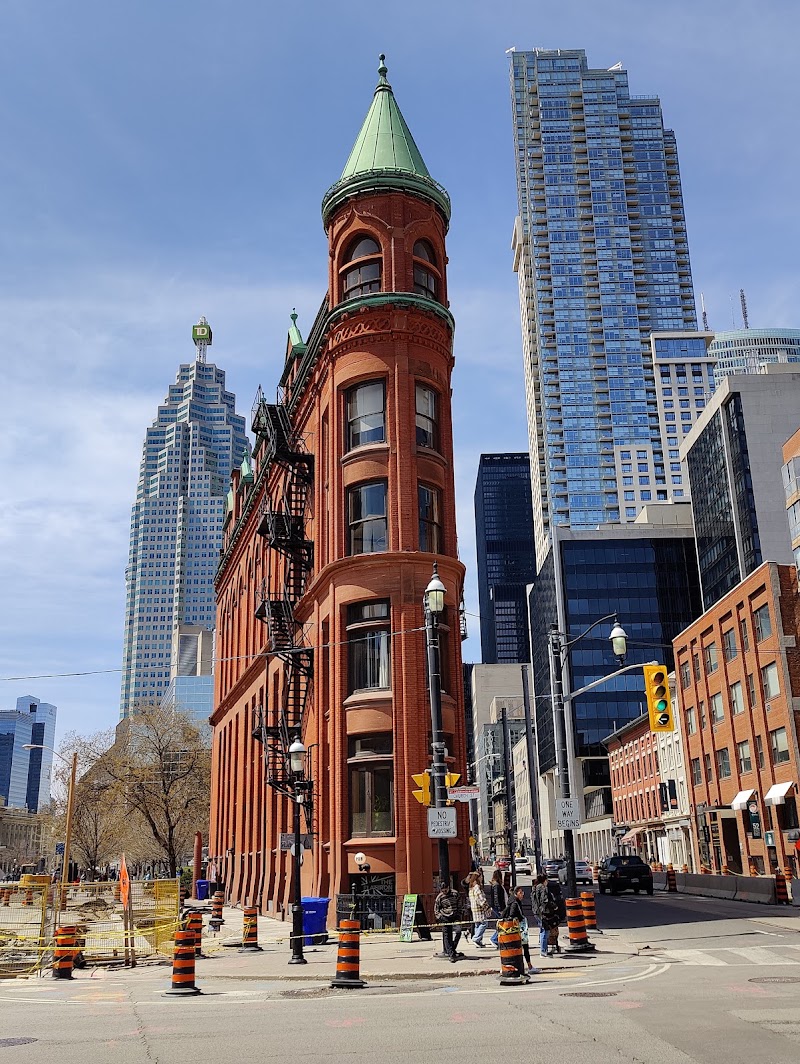
- The Gooderham Building — Toronto’s flatiron, completed in 1892 to a design by David Roberts Jr. for the distiller George Gooderham Sr., five storeys of red-brick Romanesque Revival narrowing to a wedge. It was designated under the Ontario Heritage Act in 1975 and closes the park’s eastern point.
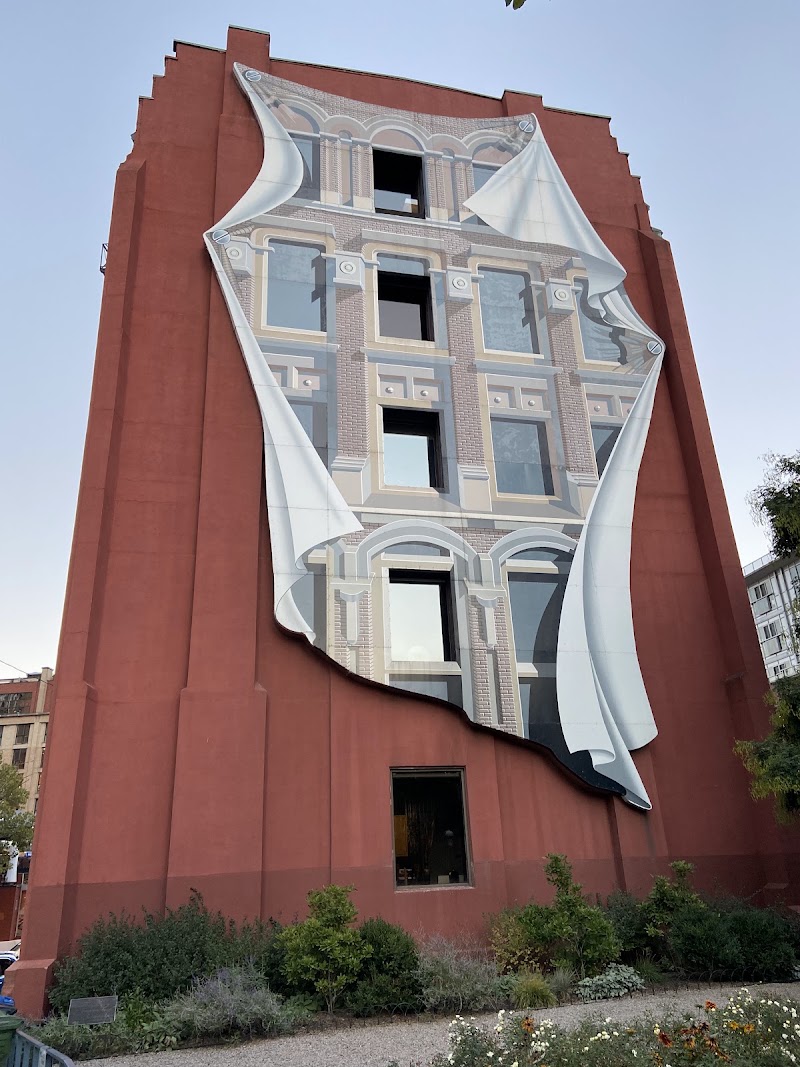
- The Flatiron Mural — Derek Michael Besant’s trompe-l’œil on the building’s rear wall, painted to look like a sheet of windows peeling away from the brick with its edges fluttering. The windows it depicts are those of the Perkins Building across the way, not of the flatiron itself.
- Fifty new trees — planted during the reconstruction into Silva Cell growing chambers, each with about thirty cubic metres of soil beneath the pavement, which is why a park this small can support a real canopy rather than the usual stunted downtown saplings.
What you’ll find
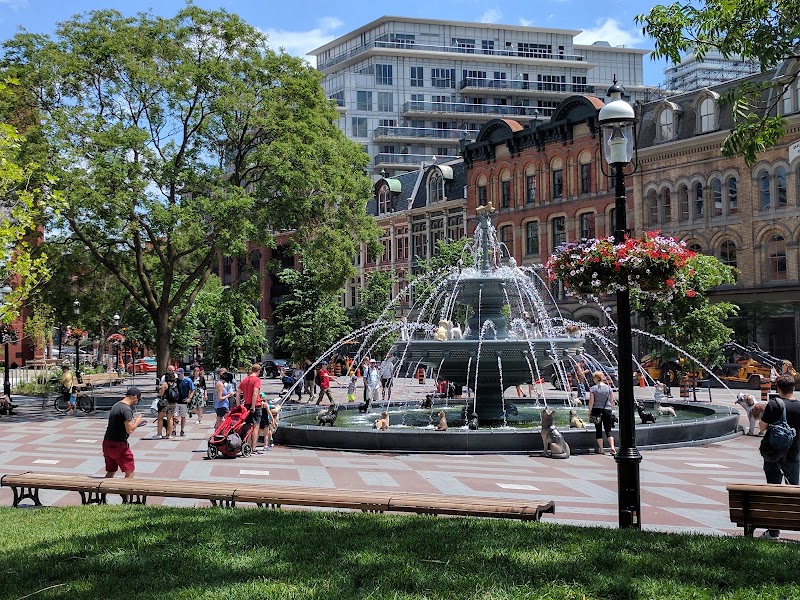
The rebuilt park is arranged as a set of overlapping rooms on a triangle, with the fountain as the hinge — hard plaza where the crowds gather, planted berms where people retreat, and a distinctly canine zone off to one side.
- The central fountain plaza with generous seating on all sides, in constant use from spring through autumn.
- Grassy berms and deep garden beds that lift the planting above pedestrian level and give the small site some visual depth.
- A pea-gravel dog relief area, separated from the seating and the lawn.
- Movable and fixed seating under mature trees, oriented so that most of it faces the fountain.
- Public artwork by Luis Jacob, commissioned as part of the park’s reconstruction.
- An immediate ring of restaurants, cafés and patios on the surrounding blocks, plus St. Lawrence Market a few minutes away, so the park doubles as an outdoor dining room in the warm months.
Things to do — and who it’s for
- Dog owners — this is the neighbourhood’s living room. The trough, the relief area and the sheer density of dogs make it the default meeting point for anyone walking one downtown.
- Families with small children — twenty-seven animals to find, count and name, water they can safely reach, and a park small enough that nobody gets lost.
- Photographers and design travellers — the fountain against the flatiron and its painted mural is one of the tightest, most rewarding compositions in the city, and it works in every season.
- Office workers and market shoppers — a genuine lunchtime destination in the middle of the Old Town and financial district edge, with food available on every surrounding block.
- Architecture and heritage enthusiasts — one small square gives you an 1892 landmark, a celebrated piece of 1980s mural art and a landmark 2017 landscape all at once.
- Anyone in need of ten cheerful minutes — the park has no agenda beyond delight, and it delivers reliably.
Getting there & practical
Berczy Park sits in Old Town Toronto, in the St. Lawrence Market district on the eastern edge of the downtown core, a few minutes’ walk from the financial towers. By subway, Union Station and King station on Line 1 Yonge–University are both roughly five to eight minutes away on foot; from Line 2 Bloor–Danforth, transfer at Bloor–Yonge and come south. The 504 King streetcar passes a block away, the 503 Kingston Rd and 304 King night services run the same corridor, and the 121 bus serves the Esplanade side. Entry is free, there are no gates and no tickets, and City of Toronto park hours apply with public parks closed overnight. The fountain is a seasonal installation: it runs roughly from spring into autumn and is shut down and drained for the winter, and it has occasionally been taken out of service for restoration, because a decade of very heavy use is hard on cast iron and plumbing alike. Fifteen to twenty minutes covers the park properly; longer if you eat nearby or combine it with St. Lawrence Market.
When to visit
Summer is peak Berczy: fountain at full pressure, every bench occupied, dogs queueing for the trough, patios spilling into the surrounding blocks and a continuous rotation of people photographing the same twenty-seven animals. Late spring is the connoisseur’s window — the water is switched on, the new planting is at its freshest and the tourist volume has not yet peaked. Autumn brings the best light of the year onto the red brick of the flatiron, the beds are still full, and the fountain usually runs into October. Winter shuts the water off and reveals what the park actually is: a sculptural triangle of iron animals under snow, with the dogs wearing white caps, the bone above them and the flatiron’s mural stark against a grey sky. Toronto locals treat the snow-covered dogs as an annual photograph in their own right, and the surrounding restaurants make it easy to warm up afterwards. Come at night in any season — the fountain and the flatiron are both lit.
Good to know
The park is named for William Berczy, born Johann Albrecht Ulrich Moll in Germany in 1744, a painter, architect and land surveyor who led a party of German settlers into what is now Markham in the 1790s and worked alongside John Graves Simcoe in the founding of York, the settlement that became Toronto. He is remembered as much for his portraiture — including a celebrated painting of the Mohawk leader Joseph Brant — as for his surveying, and he died in 1813. The land the park occupies had an office building on it before the 1950s, and after its demolition the site served as a parking lot until the park opened in 1980. For thirty-five years it was pleasant and forgettable. It closed in September 2015 for the first full renovation in its history, a 7.2-million-dollar reconstruction designed by the Montreal landscape architect Claude Cormier, and reopened on 28 June 2017. Cormier’s approach — one big, warm, unembarrassed idea, executed with obsessive attention to detail — had already produced the yellow umbrellas at HTO Park in 2007 and the pink umbrellas of Canada’s Sugar Beach in 2010; Berczy Park is generally considered his masterpiece in the city, and he died in 2023 with it as his most-loved Toronto work. The consultation process shaped the content directly: local residents asked for something for their dogs, and the design answered with twenty-seven of them, a ground-level drinking trough, and a single cat as a joke inside the joke. Councillor Pam McConnell, who pushed the rebuilding through, died in July 2017, weeks after the reopening; the cat carries her name. Behind it all, the Gooderham Building has stood since 1892, its wedge shape making it one of the most recognizable views in the city, and Derek Michael Besant’s mural has covered its rear wall since the early 1980s — a painted illusion in which the windows appear to lift off the brick and curl at the edges.
Visitor tips
- Walk the full circle of the fountain rather than photographing it from one side — every dog is a different breed, and half the pleasure is spotting your own among them.
- Find the cat before you leave. There are two: Pam McCat on the fountain, looking at the birds instead of the bone, and a second one perched on an electrical box at the far corner of the park.
- The classic shot is the fountain in the foreground with the flatiron and its mural behind — stand at the western end of the park and shoot east, ideally in late-afternoon light.
Questions & answers
How many dogs are on the Berczy Park fountain? Twenty-seven cast-iron dogs, each sculpted as a different breed, all spouting water toward a gilded bone at the top. There is also one cat on the fountain and a second cat on an electrical box at the park’s corner.
Who is the cat named after? Pam McCat is named for Councillor Pam McConnell, who championed the park’s reconstruction. She died in July 2017, only weeks after the park reopened.
Can I bring my dog? Yes, and the park was designed for it. A shallow trough at the base of the fountain lets real dogs drink, and there is a dedicated pea-gravel relief area away from the seating.
Is the fountain on all year? No. It runs from roughly spring through autumn and is drained for the Toronto winter. It has also been taken offline for restoration work at times, since it is used extremely heavily.
Who designed the park and when did it reopen? The Montreal landscape architect Claude Cormier led the 7.2-million-dollar rebuild. The park closed in September 2015 and reopened on 28 June 2017 — the first full renovation since it originally opened in 1980.
What is the triangular building behind the park? The Gooderham Building, completed in 1892 by architect David Roberts Jr. for the distiller George Gooderham Sr. It is Toronto’s flatiron, five storeys of Romanesque Revival brick, designated under the Ontario Heritage Act in 1975.
Are the windows on the back wall real? No. That is the Flatiron Mural by Derek Michael Besant — a trompe-l’œil painting that depicts the windows of the Perkins Building across the way, rendered as a sheet peeling off the brick with fluttering edges.
Who was William Berczy? A German-born painter, architect and surveyor, born in 1744, who brought German settlers to the Markham area in the 1790s and worked with John Graves Simcoe in founding York, the town that grew into Toronto. He died in 1813.
How long does a visit take? Fifteen to twenty minutes is enough for the fountain, the mural and a circuit of the park. It combines naturally with St. Lawrence Market and the surrounding Old Town blocks for a half-day.
Photos
Show 1 more photos
Visitor reviews
Reviews last updated: 2026-08-03 23:54:26
Data is refreshed monthly. Sources: toronto.name and editorial picks based on reviews.
This has been our (my friends' and mine) favorite charming place to visit over the past 2 months. We managed to visit it a month ago, when the fountain was still working. Now it's been drained. There's plenty of seating…
An absolutely lovely park around the Esplanade downtown. Next to St. Lawrence Market, right by the Flatiron Building. There are plenty of great restaurants and bars around worth visiting. Tables and chairs are set out be…
Berczy Park is a public park located in the very heart of downtown Toronto, Canada. The park is named after William Berczy, an artist, soldier, and pioneer of German origin, known for his role in the early settlement of…
A nice little park with a unique dog fountain. It was really cool to see the dogs at work. Plenty of benches to sit and relax. The only downside was the drunk homeless people loitering on the wall by the fountain, and it…
The park is too small, but it has a wonderful fountain where water shoots up from a dog's mouth.
Nice arrangement of the seating. All sides are open. So you can enter and exit from any side. At the end there's a wonderfu…