

Ontario is one of Canada’s most popular provinces, as toronto.name highlights. This region holds countless historical secrets that shed light on its past. However, the significance of Ontario’s history extends far beyond its borders, playing a vital role in the development of global trade and economic relations.
Ontario has long been a pivotal player in the foundation and advancement of leading nations. Beyond this, the province boasts numerous landmarks that allow visitors to delve into its character and culture. These sites—historical witnesses to events of the past—provide a glimpse into Ontario’s rich legacy.
Many parks, squares, and recreational areas have existed for decades, embedding themselves in the province’s history. Visitors to these locations can experience the authentic past of the region.
One such site is Bruce Peninsula National Park, which boasts a unique and ancient history. Although the park was officially established in the 1980s, its story stretches back hundreds of millions of years. This incredible longevity underscores its immense value, with numerous unique artifacts continually unearthed by experts.
Official Establishment
The Bruce Peninsula National Park was officially established in 1987. It is considered the heart of the Niagara Escarpment Biosphere Reserve and is the largest protected area in southern Ontario.
The Landscapes
Bruce is renowned for its diverse landscapes. Visitors can find barren soils with sparse vegetation, as well as lush forests. The park is also home to several pristine lakes.
The park offers countless recreational opportunities, including hiking, camping, and wildlife observation. For outdoor enthusiasts, there are numerous trails ranging in difficulty, catering to all skill levels.
Once a Sea?!
One fascinating historical fact about Bruce Peninsula National Park is that approximately 400 million years ago, the area was covered by a vast sea. This marine environment was home to mollusks and coral species.
Experts believe that this prehistoric ecosystem resembled the Great Barrier Reef of today.
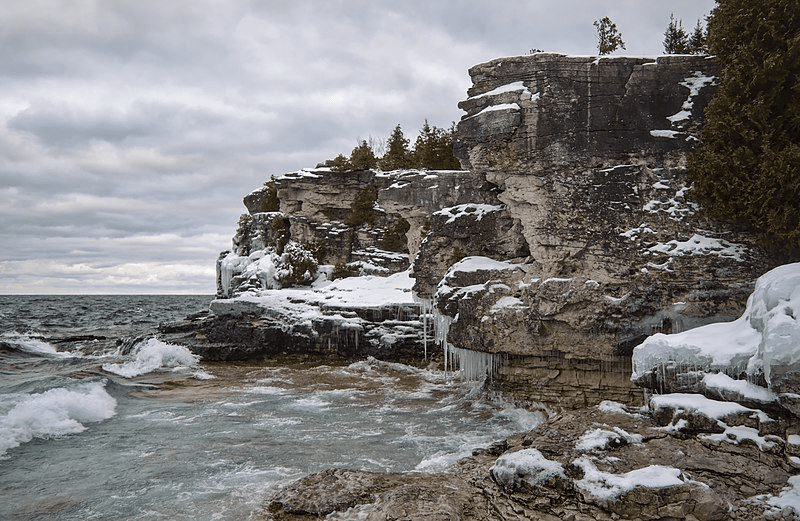
As the sea receded, the minerals solidified into dolomite rock. This geological transformation resulted in the stunning cliffs that now define the park’s iconic landscape.
Flora
The park is a haven for plant lovers, featuring over 32 species of ferns and 34 species of orchids, including some that are nearly extinct in the wild.
The forest canopy includes species such as white cedar, fir, spruce, poplar, birch, beech, and maple. Visitors can also marvel at the park’s vibrant wildflowers, algae, lichens, and mosses.
Fauna
The park is also home to a variety of wildlife, making it a captivating destination for animal observation. Because the animals roam freely in their natural habitats, their behaviours are unrestricted by enclosures or human intervention.
Among the species found here are American black bears, chipmunks, and eastern massasauga rattlesnakes.
Bruce Peninsula National Park stands as a remarkable blend of natural beauty and ancient history, offering visitors a chance to connect with the past and marvel at the wonders of the present.