

The city of Toronto and the Niagara Region are rich in fascinating history, which is also an integral part of Canada’s story. Today, we’ll talk about the incredible Niagara Falls. Read on at toronto.name.
Formation of the Falls
The Niagara River and the entire Great Lakes Basin, of which it is a part, are a legacy of the last ice age. About 18,000 years ago, southern Ontario was covered by ice sheets two to three kilometres thick. As the glaciers advanced southward, they carved out the basins of the Great Lakes. It was during the final melt that a vast amount of water filled these basins. It’s also known that less than one percent of this water is replenished annually; the rest is meltwater from the ancient ice sheets.
The Niagara Peninsula became ice-free approximately 12,500 years ago. As the glacier retreated north, the meltwater began to drain. It filled Lake Erie, then the Niagara River and Lake Ontario, before flowing into the St. Lawrence River and out to the Atlantic Ocean. Initially, there were five outlets from Lake Erie to Lake Ontario. Eventually, only one remained—the original Niagara Falls, located on the escarpment in the Queenston-Lewiston area. From there, the falls began to slowly erode the hard rock foundation.
However, about 10,500 years ago, this process was interrupted by a combination of geological factors, including alternating retreats and readvances of the glaciers, as well as the rising of the land after being freed from the immense pressure of the ice (a process known as isostatic rebound). The glacial meltwaters were rerouted through northern Ontario, bypassing the southern route. For the next 5,000 years, Lake Ontario was only half its current size, and the Niagara River’s flow was reduced to just 10% of its present volume. As a result, the waterfall stalled in the area of the Niagara Gorge.
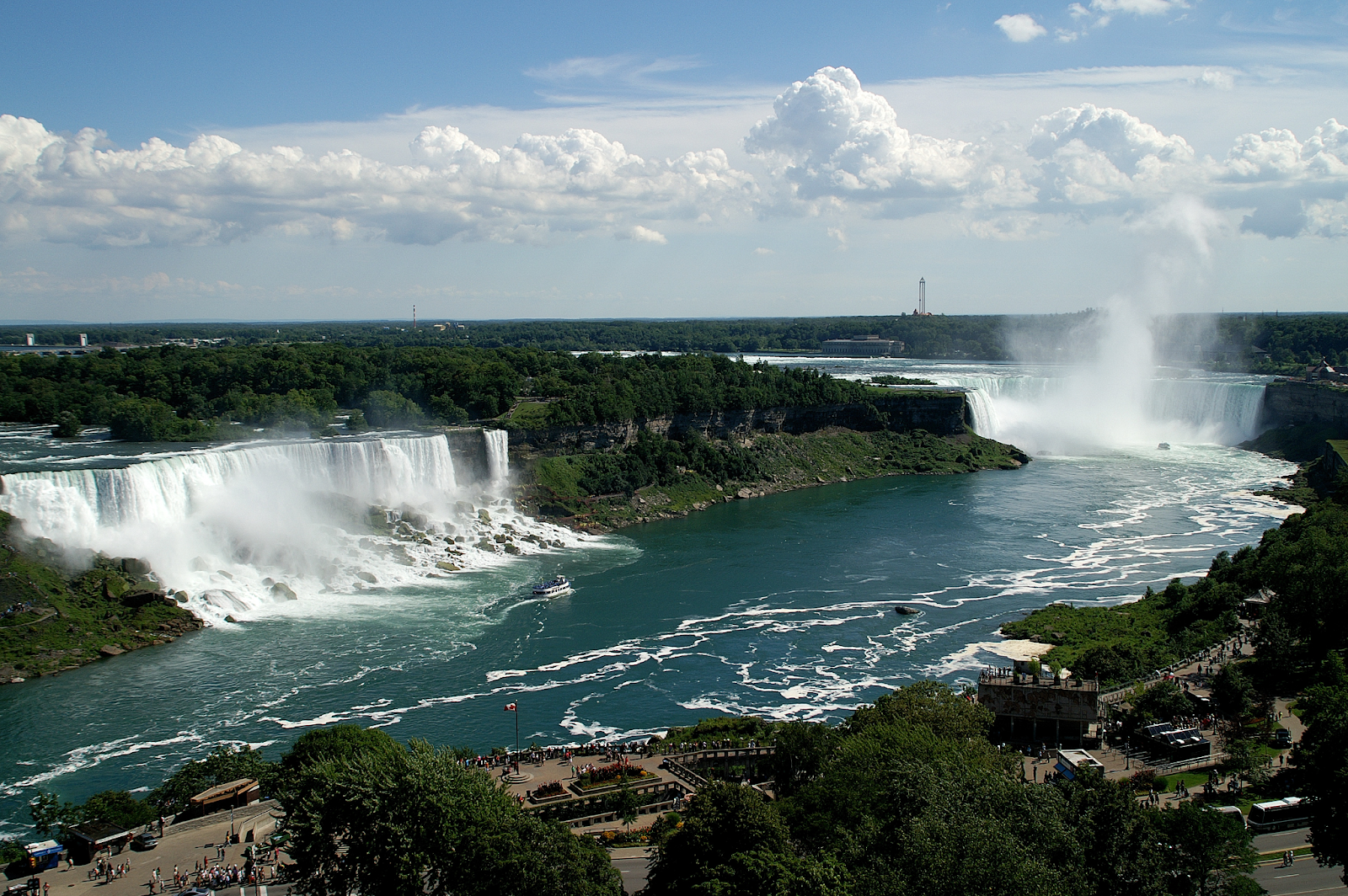
Then, about 5,500 years ago, the meltwaters returned to southern Ontario, restoring the power of the river and the falls. The flow eventually reached the Whirlpool. This was a brief and turbulent encounter, a geological event that lasted only a few weeks, perhaps even just days. During this time, the falls of the young Niagara River intersected with an ancient riverbed that had been sealed off by natural processes, including glacial deposits (clay, sand, rock, etc.). The falls plunged into this hidden gorge, tearing out the glacial debris that filled it and clearing the bottom of the old river. At that point, it likely ceased to be a waterfall and became a massive, churning rapid. This event left behind a 90-degree bend in the river, known today as the Whirlpool, and North America’s largest series of standing waves, called the Whirlpool Rapids.
The Freezing of the Falls
There is only one recorded instance of the Niagara Falls’ flow stopping completely due to freezing. This occurred on March 29, 1848. Following an exceptionally cold winter, a warming trend caused the thick ice of Lake Erie to break apart. A strong east wind then pushed the ice into an ice jam at the mouth of the Niagara River, blocking the flow of water to the Horseshoe Falls. (When the water thunders over the falls onto the rocks below, it freezes, forming an “Ice Bridge” that connects the American and Canadian banks).
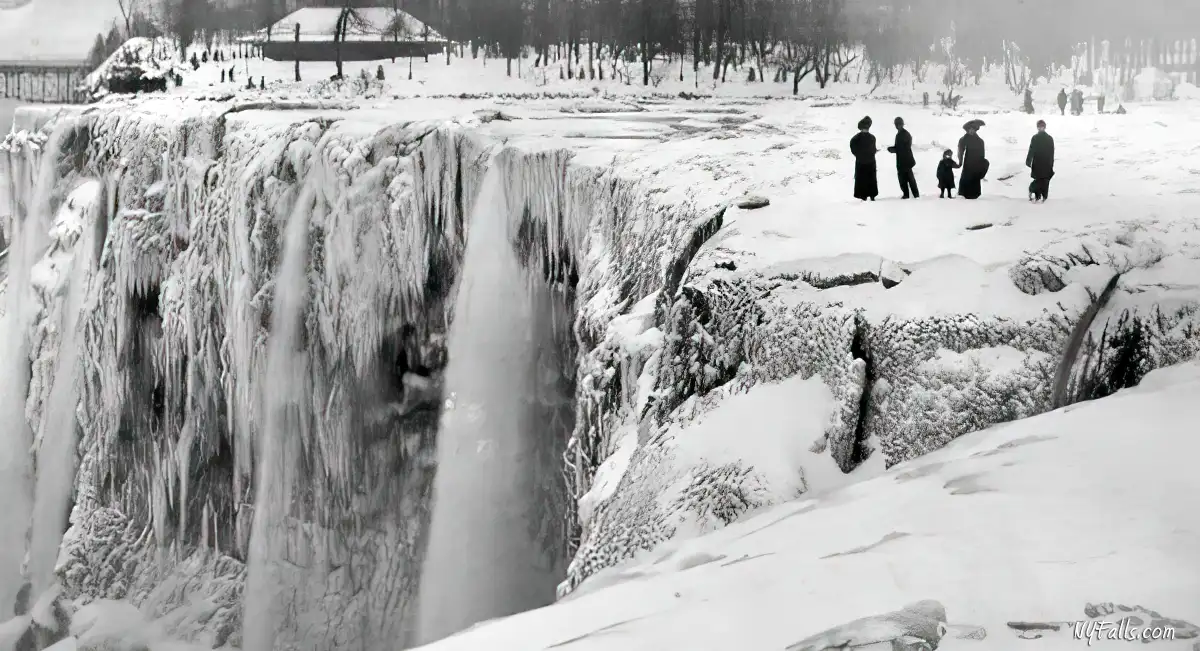
In years past, the “Ice Bridge” was a popular tourist attraction. Canadian and American visitors would gather in one place to admire the incredible beauty created by nature itself. They also enjoyed fresh drinks and food offered by entrepreneurs who set up concession stands during the cold season.
This continued until a tragic incident on February 4, 1912. On that day, the bridge collapsed, and three people were swept into the river’s current, leading to their deaths. Since then, walking on the “Ice Bridge” has been prohibited. While the falls freeze partially during most winters, making the area dangerous, significant icing was notably observed in the years: 1895, 1902, 1906, 1911, 1932, 1936, 2014, and 2017.
The illusion of the falls being completely frozen is created by a crust of ice forming on the exterior, while underneath this shell, water continues to flow uninterrupted.
The War of 1812
The War of 1812 marked a turning point in the history of Niagara Falls. It was a time when the young United States Army fought against British Loyalists for new lands that would eventually become part of Canada.
Niagara’s historic sites, battlefields, museums, and military reenactments offer a fascinating journey into the past. You can witness history meticulously restored and recreated from Fort Erie to Niagara-on-the-Lake. For example, at Old Fort Erie, guides in authentic 1812-period costumes bring the life of a former British garrison to life, featuring daily musket demonstrations and the annual reenactment of the Siege of Old Fort Erie. This area also served as an entry point for enslaved Black people seeking freedom from persecution in the U.S. The crossing point into Canada from Buffalo was known as the “Crossing” and was also called the “Freedom Trail.” The region is home to numerous historical sites, including Brock’s Monument, a tribute to the British general who fell at the Battle of Queenston Heights in 1812.
Niagara Falls History Museum
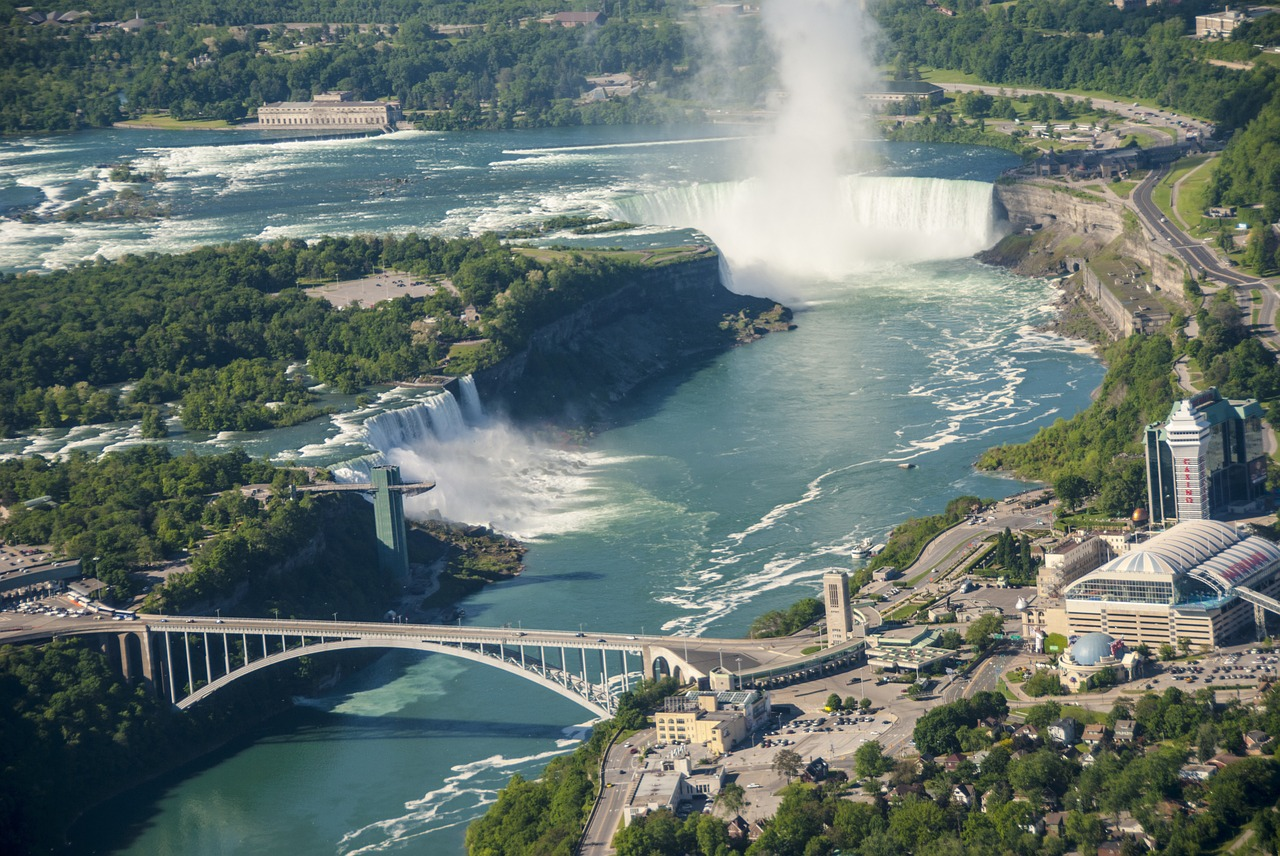
At this museum, visitors can explore the history that shaped a nation through authentic artifacts, images, videos, and interactive exhibits designed for a full immersion into the region’s significant events. The Niagara Falls Gallery offers a chance to experience the history of the legendary waterway, from its geological formation to the daredevils who challenged the raw power of nature.
Tourism in Niagara Falls acknowledges that this area is the traditional territory of the Haudenosaunee and Anishinaabe peoples, many of whom continue to live and work here today. Furthermore, this territory is covered by the Upper Canada Treaties and falls within the land protected by the “Dish With One Spoon Wampum” agreement. Today, this place is home to numerous First Nations, Métis, and Inuit peoples, which shows that their well-being is closely tied to the natural resources and mutual support among Indigenous nations.
This includes peoples such as the Hatiwendaronk (Neutral), Haudenosaunee, Anishinaabe, and the Mississaugas. As of 2024, First Nations, Métis, and Inuit peoples from across Turtle Island (a name for the continent based on creation stories) live and work in the Niagara territory. The Regional Municipality of Niagara supports the initiatives of Indigenous peoples, past and present, thereby promoting responsible and wise stewardship of the lands.
Overall, the Niagara Falls area holds a rich and deep historical context for the First Peoples who began to settle this land over 13,000 years ago. As the glaciers disappeared, retreating northward, they uncovered the great Lakes Erie and Ontario, as well as the Niagara River, which laid the foundation for the region’s development. These waters and natural resources have always been of great importance to the local tribes, providing food, transportation, and a cultural foundation for their existence.