

It is fair to say that the origins of hydropower development in Canada are closely tied to Niagara Falls, writes toronto.name.
Despite beginning on American soil, the majority of this majestic waterfall is located in Canada.
Interestingly, Niagara Falls is over 100 kilometres from Toronto, yet it remains one of the city’s most iconic attractions.
But let’s shift our focus to the realm of energy.
In 1885, the Canadian government designated the coastal area around Niagara Falls as parkland.
However, creating and maintaining these parks proved to be an expensive endeavour. This sparked the idea of covering some of these costs by building a hydroelectric power plant.
Investors quickly embraced this initiative.
More details about what happened next can be found in this article, referencing nflibrary.ca.
A Pivotal Project
In 1892, the Niagara Power Company began operations.
Among its investors were several financial magnates. The company was managed by William Rankine, after whom the completed hydroelectric power plant was eventually named. The plant first generated electricity on January 1, 1905.
Engineers determined that the most practical location for the power plant was near the falls.
The intake structures and the cliff were separated by less than 300 metres.
The power plant’s design included vertical shafts, turbines, and long shafts connecting the turbines to the generators.
Construction of the plant was fully completed in 1927, with a capacity of 75 megawatts.
The Rankine Power Station operated until 2001, without undergoing any significant upgrades.
For a time, it remained on standby, before being permanently decommissioned in 2009.
The site was later handed over to the Niagara Parks Commission, with plans to transform the former hydroelectric station into a museum.
A New Design
The second hydroelectric power station in Ontario was constructed by the Ontario Power Company and opened in 1905.
The design of this facility was significantly different from the earlier one.
Located downstream of the falls, the new plant featured modern and efficient diversion systems, including equalizing reservoirs.
This station had a capacity of 132.5 megawatts.
The facility operated for many years, though it was flooded in 1909 and 1938 due to extreme rises in water levels in the lower basin.
In 1999, the outdated station was closed. The water it used could be more effectively utilized by newer stations.
Additionally, the site of the station’s switchyard was repurposed for the construction of a new casino.
However, the station’s building and other structures were not demolished.
A “Hydropower” Landmark
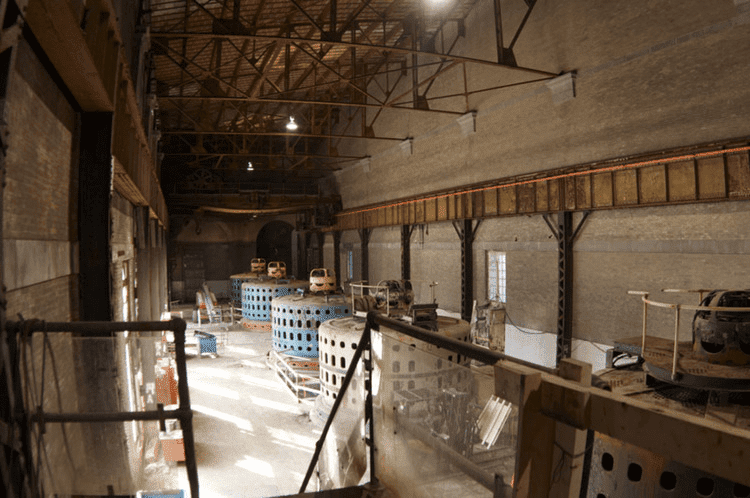
Another hydroelectric power station was constructed by the Toronto Power Company and opened in 1906.
A notable feature of this plant was its system of tunnels, which merged into a single tunnel with a diameter of 10 metres.
The facility had a capacity of 98 megawatts and operated until 1973.
It was later decommissioned as obsolete.
In 1983, the station was designated as a Canadian historic site.
Photo: nflibrary.ca