

The Toronto Magnetic and Meteorological Observatory is considered a historic landmark and an integral part of the University of Toronto. Established in 1840 by scientist Edward Sabine, the observatory was part of a large-scale research project that concluded in 1853. It was significantly expanded under the direction of the Canadian government and served as the country’s official meteorological station for the next fifty years. Known as the cradle of Canadian astronomy, this scientific institution has left an indelible mark on the nation’s scientific history. Learn more on toronto.name.
How the Toronto Magnetic and Meteorological Observatory Was Founded
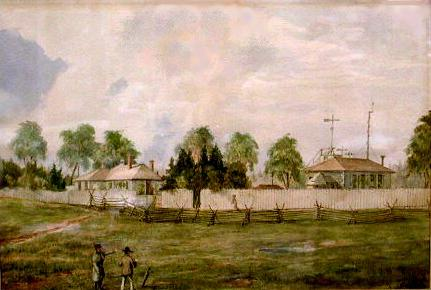
In the first half of the 19th century, with the support of the British government, observatories were constructed worldwide to study Earth’s magnetic field—a field of science that required further exploration and understanding. Initially, the institution was planned to be built on Saint Helen’s Island in Quebec, near Montreal, on the St. Lawrence River. However, this location proved unsuitable for a meteorological observatory, leading to Toronto’s selection instead.
A team arrived in Canada in 1839 to prepare for construction and temporarily settled in the abandoned barracks of Fort York, a historic military post in central Toronto. Four hectares of land west of King’s College were allocated for the observatory. Construction was completed the following year, and the facility was named the Toronto Magnetic and Meteorological Observatory.
The site featured two primary buildings: one housing magnetic instruments and another partially underground for future experiments. A specialized theodolite was installed in the main building to measure horizontal and vertical angles.
To meet scientific requirements, both buildings were constructed with minimal use of metal, relying instead on non-magnetic materials like copper and brass. Additionally, barracks were built nearby to house officers.
Edward Sabine began his observations and research at this facility. He identified that magnetic variations fell into two categories: short-term and long-term. Short-term variations were influenced by the day-night cycle, while long-term changes were linked to the number of visible sunspots. Sabine detailed these findings in two articles published in the Philosophical Transactions of the Royal Society in 1851 and 1852. He continued his research on magnetic field variations, publishing a third article on the subject four years later.
Activities Under the Leadership of John Henry Lefroy
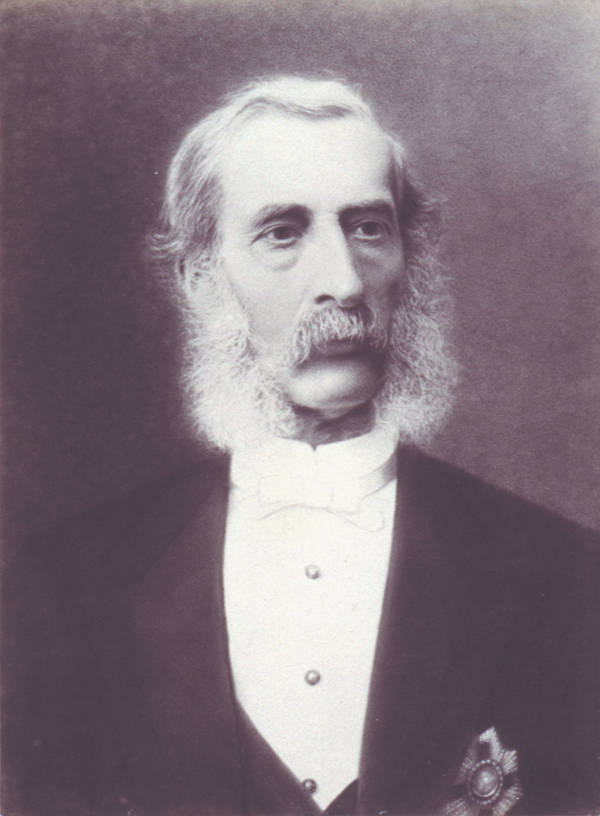
Sir John Henry Lefroy, an English military officer, made significant contributions to the study of Earth’s magnetism. As one of the first researchers in this field, he achieved remarkable success. In 1842, he was appointed director of the Toronto Magnetic and Meteorological Observatory, a position he held until 1853. During his tenure, Lefroy married Emily Mary of Toronto in 1846, with whom he had two daughters and two sons. His dedication to science secured his place in history.
In recognition of his contributions, the Ontario Heritage Trust installed a commemorative plaque honoring John Henry Lefroy on the University of Toronto campus in 1960.
The Observatory’s Later Years
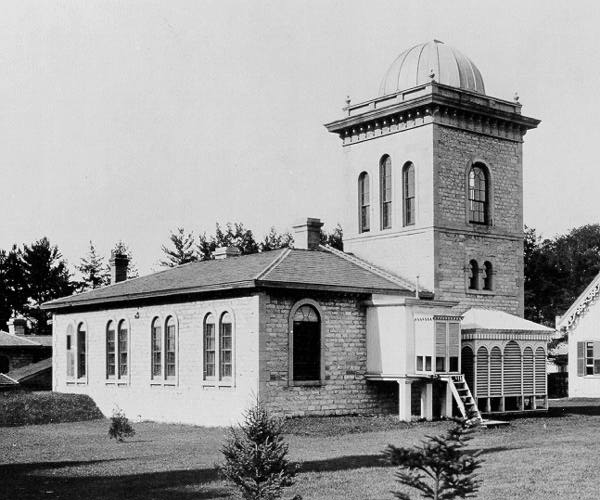
By 1853, the Royal Society’s large-scale project was nearing completion, and the observatory faced potential closure. Fortunately, this did not happen. While other observatories of the era disappeared, the Toronto facility expanded its focus to include both magnetic and meteorological research. Responsibility for the observatory’s operations shifted to the Department of Fisheries and Oceans, and temporary structures were replaced with permanent buildings.
Architect Frederick Cumberland designed the new stone observatory in 1853, featuring a theodolite mounted on its roof. Construction was completed in 1856, and George T. Kingston, regarded as the father of the Meteorological Service of Canada, was appointed director.
The observatory received data daily from 312 Canadian stations and 36 American stations. Each station was equipped with instruments such as mercury barometers, minimum and maximum thermometers, anemometers to measure wind speed, weather vanes, and rain gauges. Reports were sent to the observatory twice daily, at 8:00 AM and 8:00 PM, and used to create 36-hour weather forecasts, which were distributed nationwide.
The observatory’s work extended beyond meteorology. In 1880, it played a crucial role in researching universal time. Until 1905, the observatory served as Canada’s official timekeeper, a role later transferred to the Federal Observatory in Ottawa. At 11:55 AM, fire station clocks in Toronto would chime based on electric signals sent from the observatory.
In 1881, Director Charles Carpmael proposed acquiring a high-quality telescope to enhance the observatory’s capabilities, particularly for studying the impact of sunspots on weather. However, poor weather conditions hindered the telescope’s effectiveness in observing key astronomical phenomena.
The Final Years of the Observatory
In the 1890s, the rapid construction of new buildings around the University of Toronto negatively impacted the observatory’s instruments. Factors such as streetcar electrification and the use of metal in construction posed challenges.
A new magnetic observatory was established in Agincourt, Toronto, in 1898, while the original observatory shifted its focus to meteorological and solar observations. The Agincourt facility operated until 1968, after which its functions were transferred to Ottawa.
Despite these changes, the University of Toronto observatory faced ongoing challenges. Dust from nearby construction sites disrupted meteorological instruments, and night lighting interfered with astronomical observations. These factors necessitated the relocation of the observatory.
A new building was constructed on Bloor Street in the northern part of the university campus. The original structure, however, was not immediately demolished. Efforts by Professor Louis Beaufort Stewart from the Faculty of Applied Science and Engineering temporarily preserved the old observatory. It was ultimately dismantled in 1907, with materials reused for the new facility.
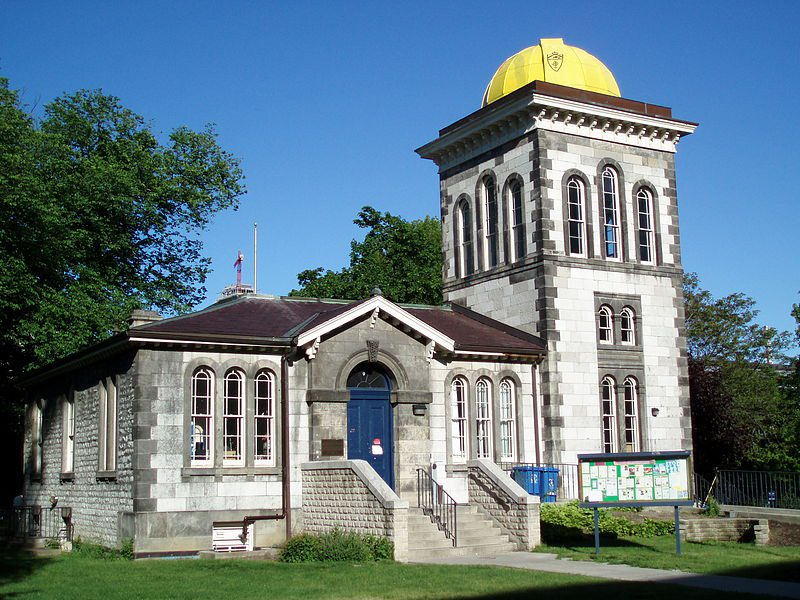
The observatory continued operations until 1950, after which it was repurposed. It served as a police station and a telephone hub before being renamed the “Louis Beaufort Stewart Observatory.” In 1953, it became home to the University of Toronto Students’ Union. Each year, engineering students repaint the observatory’s dome as a tribute to its historical significance as the Toronto Magnetic and Meteorological Observatory.